Why Do Narcissists and Fools Command Loyalty?
The qualities that carry people into power are often not the qualities needed to use it well. Sometimes they are their opposites. A society may therefore select its most dangerous leaders not despite their defects, but because those defects first appeared to be strengths.
One of the strangest failures in public life occurs when everyone can see that an individual is poorly equipped to govern, yet the machinery of power continues to lift them upward.
The candidate is vain, but vanity is interpreted as confidence. They know little, but ignorance is praised as freedom from stale expertise. They lie easily, but dishonesty is renamed strategy. Their attention wanders from duty toward spectacle, grievance, self-enrichment, or personal mythology, yet supporters insist that such behavior proves authenticity. The leader is not restrained by ordinary standards, and this exemption itself becomes part of the attraction.
The intelligent observer is left asking an obvious question: how can this happen?
The reassuring answer is that the public was deceived. The less reassuring answer is that many people saw what was happening and chose it anyway. Some wanted a weapon against their enemies. Some expected private advantage. Some believed the candidate could be controlled. Others were seduced by theatrical certainty at a moment when reality had become difficult, complicated, and frightening.
The wrong leader rarely reaches power alone. They are carried there by people who imagine they will benefit from the ascent.
Rome knew this danger. Its political traditions had been designed, at least in principle, to prevent the inexperienced from moving too rapidly into command. The cursus honorum required public offices to be approached in sequence. The Senate took its name from senes, the elders, reflecting the belief that government demanded maturity, memory, and judgment. Furthermore, Roman writers repeatedly described youth as a precarious interval in which appetite was strong, identity unfinished, and self-command still under construction.
Yet in 218 CE, the Roman world placed a fourteen-year-old Syrian priest at the head of the empire.
His name was Varius Avitus Bassianus. But history remembers him as Elagabalus, or Heliogabalus, after the solar deity whose hereditary priest he had been in the city of Emesa, in Roman Syria. He had no military command, no administrative record, no experience of the Senate, and no tested understanding of the immense political organism he was about to inherit. What he possessed was ancestry, appearance, religious charisma, and usefulness to ambitious adults.
His grandmother, Julia Maesa, was the formidable sister of the former empress Julia Domna. After the emperor Caracalla was assassinated and replaced by Macrinus, Maesa helped spread the claim that her grandson was Caracalla’s illegitimate son. The boy resembled the dead emperor closely enough for the story to gain traction. Discontented soldiers, angered by reductions in their privileges and nostalgic for the Severan dynasty, accepted him. Money strengthened conviction, dynastic myth supplied legitimacy, and military force completed the argument.
Macrinus was defeated. The Senate then recognized the result.
The sequence matters. Elagabalus was not chosen because Rome had examined his character and found him capable of carrying imperial responsibility. He was chosen because different groups found him useful. Soldiers saw the restoration of a favored dynasty. His family saw a route back to power. Political opportunists saw advancement. And the Senate saw a military reality it could ratify more safely than resist.
A child stood at the center of a coalition of adults, and each adult believed they understood the game.
This is how unsuitable people often rise.
First, confidence is mistaken for competence…
Competence is difficult to see before it has been tested. It is patient, technical, and frequently undramatic. It asks questions. It distinguishes what is known from what is merely hoped. And it may admit uncertainty because reality is uncertain.
Confidence is easier and can be displayed immediately.
The person who declares that only they can repair the state may appear stronger than the person who explains that repair will require institutions, expertise, compromise, sacrifice, and time. The one who speaks in absolutes seems decisive. The one who understands complexity seems hesitant. A demonstration of mastery frequently defeats the quieter evidence of judgment.
Elagabalus had been trained to occupy a sacred center. He knew ceremonial authority: elaborate vestments, ritual movement, music, sacrifice, procession, and the magnetism of a god embodied not in a human likeness, but in a large black conical stone — possibly a meteorite — revered at Emesa as having fallen from heaven and therefore as a tangible manifestation of divine presence. He arrived in Rome not as a statesman gradually formed by office, but as a priest already accustomed to being watched.
The distinction between governing and appearing to govern was never properly tested.
Modern leadership research confirms the danger. Narcissistic traits can help individuals emerge as leaders because confidence, extraversion, grandiosity, and assertive self-presentation resemble our mental image of leadership. Yet the same research finds no simple corresponding relationship with effectiveness once authority has been secured. The qualities that win the audition do not necessarily sustain the performance.
Second, certainty is mistaken for intelligence.
When societies are anxious, complexity becomes politically expensive. People want the world reduced to a story with a hero, an enemy, a betrayal, and a promised restoration. The leader who supplies that story may be intellectually shallow, but the emotional clarity feels like understanding.
Macrinus, whom Elagabalus’s supporters sought to overthrow, represented a complicated and uncomfortable reality. He was not a Severan. His legitimacy was contested. Military loyalty was weakening. The empire faced financial and geopolitical strain. Elagabalus offered a simpler proposition: Caracalla’s blood had returned.
Whether the claim was true mattered less than whether enough people needed it to be true.
The same process remains familiar. Economic decline becomes the work of a hidden enemy. Institutional failure is blamed on one disloyal group. A difficult war is presented as a contest that will be won through willpower alone. Environmental damage, public debt, demographic pressure, technological disruption, or social fragmentation are forced into slogans that require no serious policy and tolerate no contradiction.
Those who question the simplification are accused of weakness, disloyalty, or complicity. Intelligence becomes suspect because genuine intelligence introduces unwelcome distinctions.
The fool may therefore defeat the wise by offering certainty the wise cannot honestly provide.
Machiavelli understood why this advantage is so powerful. Writing in the violent and unstable politics of Renaissance Italy, he observed that people usually judge rulers through what they can see. The appearance of confidence, resolution, strength, and success is available to everyone; the inner quality of judgment is visible to very few.
This is often mistaken for an endorsement of deception. But Machiavelli’s deeper point is more disturbing. Political loyalty does not always form around what a leader truly is. It forms around what the leader appears able to provide: security, victory, restored dignity, punishment of enemies, or release from uncertainty. A ruler who performs these promises convincingly may command devotion long before competence has been demonstrated.
The narcissistic leader possesses an obvious advantage in such a contest. Grandiosity does not experience itself as performance. The leader may genuinely believe that ordinary limits do not apply, that personal instinct is superior to expertise, and that opposition confirms rather than challenges exceptional status. This conviction can appear more authentic than the caution of someone who understands the difficulty of governing.
The fool may enjoy a related advantage. Complexity does not trouble a mind that does not perceive it. What the thoughtful leader approaches with qualification, the foolish leader announces with certainty. Followers exhausted by ambiguity may experience this reduction not as ignorance, but as clarity.
Machiavelli also recognized that success alters moral judgment. If the ruler wins, retains office, humiliates opponents, or appears to restore order, conduct that might once have caused alarm is reinterpreted as political skill. Loyalty then attaches not only to the person, but to the continuing appearance of victory.
Narcissists and fools frequently command loyalty because they often demonstrate certainty without the restraints imposed by self-knowledge.
Third, visibility is mistaken for achievement.
The Roman emperor was not merely an administrator. He was the visible focus of military loyalty, sacred order, public benefaction, and imperial identity. Elagabalus understood visibility with extraordinary instinct. He brought the cult of his god to Rome, constructed a temple on the Palatine, placed Elagabal above Jupiter, and required Rome’s governing elite to witness ceremonies that many found alien and humiliating.
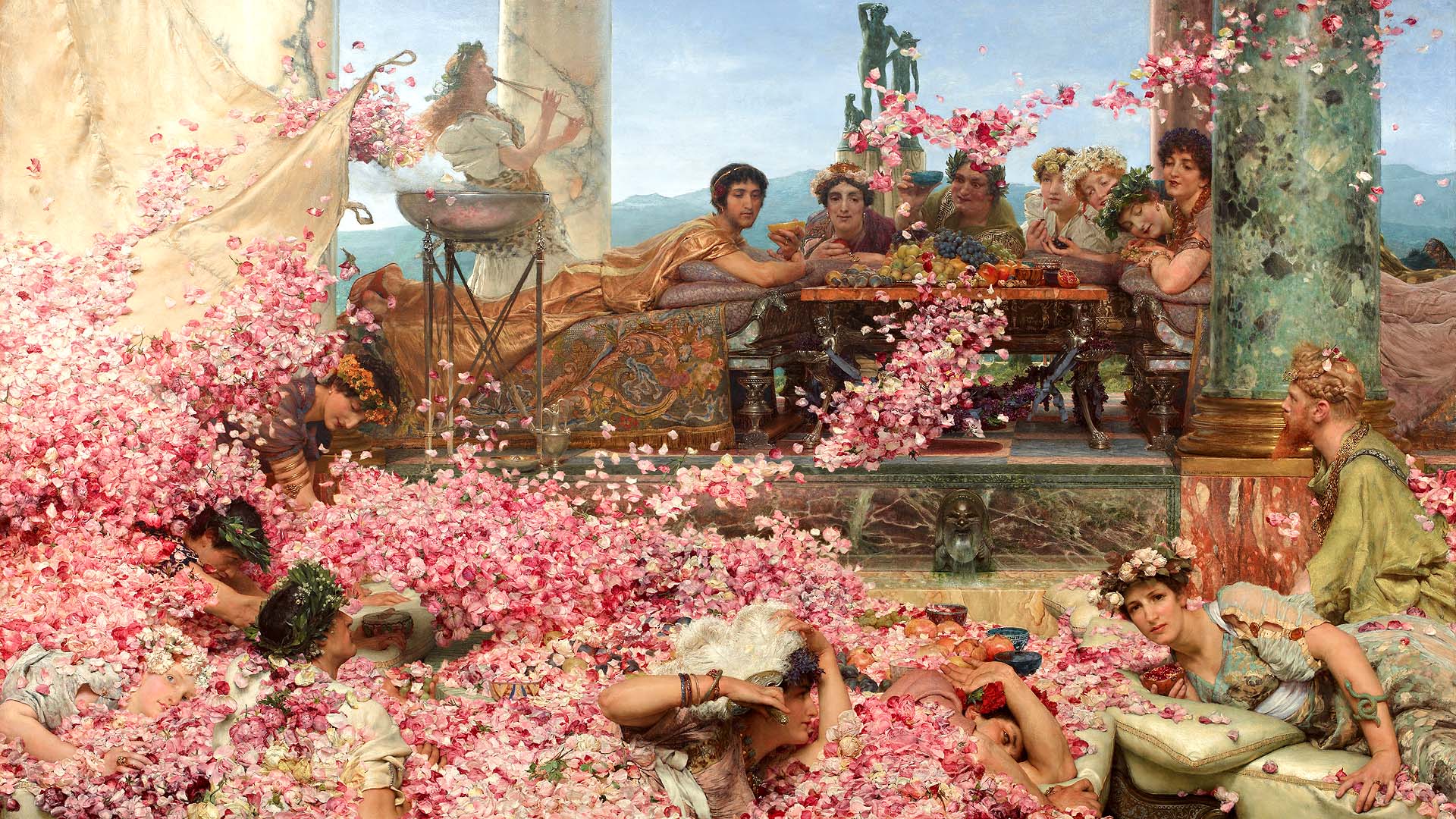
Ancient accounts surround him with perfumes, jewels, music, exotic banquets, sexual scandal, reckless appointments, and theatrical cruelty. Some stories are almost certainly hostile inventions or extravagant enlargements. The most famous image — the banquet at which guests were supposedly smothered beneath a descending mass of rose petals — comes from the Historia Augusta, written long after his death.
Yet the story survived because it captured something believable about his reign: beauty detached from judgment, luxury detached from responsibility, and spectacle descending until it became suffocation.
Lawrence Alma-Tadema understood this when he painted The Roses of Heliogabalus. The scene is exquisite. Pink petals flood the canvas while the emperor watches from above. At first the abundance appears sensual and magnificent. Only gradually does the viewer understand that the guests beneath the flowers may be dying.
That is a powerful image of corrupt leadership. The surface is enchanting. The consequence is concealed beneath it.
Modern political and institutional life has multiplied this confusion. Visibility now arrives through rallies, interviews, social media, staged confrontations, branding, wealth, celebrity, and the permanent manufacture of attention. The person who occupies the screen begins to occupy the imagination. Attention is mistaken for importance; importance for capacity; capacity for legitimacy.
A leader may fail at government while succeeding brilliantly as spectacle.
Fourth, usefulness to a faction is mistaken for fitness to govern.
Julia Maesa and her allies did not need Elagabalus to be wise. They needed him to defeat Macrinus and restore their house. The soldiers did not require administrative competence. They wanted a ruler associated with Caracalla and a return to the rewards they believed had been taken from them. The Senate did not need to admire the new emperor, but to survive the military decision already made.
Each group asked what the boy could do for them. Few asked what he might do to Rome.
This error is repeated wherever leadership is captured by faction. A political movement chooses the candidate most capable of humiliating its enemies. A board appoints the executive most likely to raise the share price before the directors’ options mature. An oligarchy supports a popular figure who can preserve privilege behind theatrical rebellion. Ideologues tolerate ignorance because ignorance makes the candidate dependent. Religious or cultural conservatives excuse vice because the sinner promises to punish the people they fear.
The test silently changes:
“Is this person fit to govern?” becomes “Can this person win for us?”
Once that substitution has been made, disqualifying traits become assets. Shamelessness promises tactical freedom. Aggression promises revenge. Falsehood promises flexibility. Narcissism supplies inexhaustible self-belief. And intellectual shallowness makes moral hesitation less likely. The leader becomes a weapon into which followers pour their fear, grievance, and frustrated appetite for domination.
But weapons do not remain obedient merely because someone else placed them in the hand.
Fifth, apparent controllability is mistaken for safety.
This may be the most dangerous error of all.
Experienced insiders often support an unsuitable leader because they believe they can manage the person from behind the throne. The candidate is inexperienced, intellectually incurious, emotionally unstable, or dependent upon praise — but such traits can easily appear advantageous. Advisers will supply the policy. Officials will preserve continuity. Generals will prevent disaster. Lawyers will control the boundaries. Family members will calm the impulses. And, last but not least, wealthy sponsors will collect the return.
Julia Maesa had lived close to imperial power and understood Rome far better than her grandson. She appears to have expected that the young emperor could serve as the sacred and dynastic face of a regime administered by older hands. His mother, Julia Soaemias, also occupied the center of power. For a time, government could continue around her.
But office changes the relationship between the puppet and the puppeteer.
The nominal ruler controls honors, access, appointments, punishments, and the distribution of attention. Courtiers begin to flatter the title rather than advise the person. Those who were supposed to contain the leader compete for favor instead. Unwelcome facts are delayed, softened, or withheld. The leader’s impulses acquire the machinery of state.
Elagabalus increasingly treated Rome as the extension of his religious and personal world. He married the Vestal Virgin Aquilia Severa, violating one of the city’s most revered religious boundaries, apparently believing that the union of Rome’s high priestess with the priest of Elagabal would create a sacred marriage. What may have possessed an internal logic in his own theology appeared in Rome as desecration enforced by imperial command.
He alienated the Senate, neglected military relationships, and allowed the legitimacy on which he depended to drain away. Julia Maesa then promoted another grandson, Severus Alexander, as a safer and more conventional alternative. Elagabalus, recognizing the threat too late, attempted to move against him. The Praetorian Guard chose Alexander. In 222, Elagabalus and his mother were killed, their bodies abused and thrown into the Tiber.
He was eighteen years old.
Rome then attempted to erase him. His name was removed from inscriptions. Images were mutilated. The failed instrument was condemned by many of the same institutions that had once recognized him.
The sources do demand some caution. Cassius Dio was a senator deeply hostile to the emperor’s conduct and Syrian religious identity. Herodian placed greater emphasis on his youth, inadequate education, political naïveté, and dependence upon Julia Maesa. The Historia Augusta transformed the reign into a carnival of depravity and grotesque entertainment. Political defamation, cultural prejudice, and retrospective justification shaped the monster history inherited.
Yet correcting the propaganda should not produce the opposite fantasy. Elagabalus was neither the pure demon of hostile literature nor merely an innocent victim of Roman intolerance. He was a teenager elevated through dynastic manipulation into absolute authority, inadequately formed for public responsibility, surrounded by interested adults, and progressively detached from the institutions on which his survival depended.
His story is sensational because the political failure itself was sensational.
Other Roman emperors reveal variations of the same danger. Nero’s early promise deteriorated amid theatrical self-absorption, fear, and violence. Commodus inherited the authority of Marcus Aurelius but treated imperial office increasingly as a stage for personal fantasy. Centuries later, Honorius presided over a Western court that became detached from military and political reality as Rome itself was sacked in 410. And Valentinian III reigned for three decades while court intrigue, dependence, and the destruction of capable servants weakened an already fractured Western Empire.
No single emperor caused Rome’s fall. The empire faced military pressure, fiscal strain, civil war, demographic change, administrative division, and profound structural transformation. Yet the repeated failure to form, select, restrain, and replace rulers played its part. A vast system could survive an imperfect emperor. But it became more fragile when imperfection was protected by flattery, faction, dynastic entitlement, and institutional cowardice.
Modern psychology gives us more precise language, but it also requires restraint. We cannot clinically diagnose Elagabalus, Nero, or Commodus across the centuries, nor can we diagnose contemporary public figures through a screen. At least, not with any precision. Narcissistic personality disorder is not a synonym for vanity, arrogance, cruelty, or political egotism. Nor, for that matter, is foolishness a medical condition.
We can, however, recognize patterns.
Grandiose narcissistic traits may promote leadership emergence because they generate confidence, visibility, and a strong claim to exceptional status. Power can then intensify self-focus, reduce perspective-taking, and encourage the powerful to treat their own knowledge as the complete field of reality. Adolescence can heighten responsiveness to novelty, reward, status, and social stimulation, although those same qualities may also support learning and courage when guided by mature institutions.
The danger lies in the combination: an unformed or disordered personality, enormous authority, constant adulation, weak restraints, frightened advisers, and a political environment that rewards spectacle over reality-contact.
The deeper value of these patterns lies not in offering a formula for choosing leaders, but in making the process of their elevation less mysterious. Public authority is rarely conferred after a calm examination of character. It is more often shaped by fear, hope, faction, spectacle, inherited loyalties, and the human preference for certainty over complexity. What later appears to have been an inexplicable political mistake may, at the time, have satisfied several powerful emotional and institutional needs.
Seen in this light, some important questions arise naturally. How does a leader respond when contradicted? What happens to capable advisers who refuse to flatter? Does loyalty gradually come to mean obedience? Are institutions still treated as part of the governing order, or merely as obstacles to personal will? Such questions do not provide an infallible test. They simply help reveal what public performance may conceal, and why societies so often recognize the danger only after power has amplified it.
Leadership requires Presence: the capacity to remain in contact with reality when power begins constructing a more pleasing version of it. It requires Power that can act without becoming appetite. And it requires Purpose that does not contract, under pressure, into self-worship, revenge, or factional advantage.
The lesson of Elagabalus is not simply that a foolish teenager once became emperor.
It is that soldiers, financiers, relatives, senators, officials, and political operators helped make him emperor because he answered their immediate needs. They mistook symbolic usefulness for governing capacity. Or, indeed, totally ignored governing capacity, believing they could benefit from his ascent and contain its consequences.
Societies still make this bargain. They raise leaders who promise emotional satisfaction, tribal victory, restored greatness, simple certainty, and punishment of the correct enemies. They notice the vanity, dishonesty, ignorance, impulsiveness, and appetite for spectacle, but reinterpret each warning as proof that the leader is strong enough to break a failing order.
By the time the petals become suffocating, the crowd has already applauded their release.
The wrong people do not rise to power alone.
They are selected, financed, excused, obeyed, and defended by those who mistake narcissism for strength, foolish certainty for wisdom, and submission for loyalty.