Before Emotional Intelligence, There Was Self-Command
The ancient world did not treat leadership as a set of presentation skills. It asked a tougher question: can a person govern anger, fear, ambition, vanity, and desire well enough to be trusted with power?
We speak often today about emotional intelligence.
The phrase is modern, but the concept is ancient. Long before leadership programs taught self-awareness, empathy, resilience, influence, psychological safety, and executive presence, classical writers were already asking whether a leader could understand himself, govern his reactions, read the emotional condition of others, and act with judgment under pressure.
They did not call this emotional intelligence. They usually addressed it inside larger topics: character, virtue, self-command, prudence, moderation, practical wisdom, authority, and duty. Their concern was not simply whether a leader could communicate well or build rapport. It was whether a leader had been formed deeply enough to carry power without being possessed by it.
The difference is important.
Much contemporary leadership training begins with behavior. How does the leader speak? How do they motivate others? How do they handle conflict? How do they build trust? All important questions. But ancient leadership thought often began one step earlier. It asked what kind of person was doing the commanding, and of course the visible activities of speaking, motivating, deciding, correcting, rewarding, and punishing.
The classical assumption was direct: leadership begins with the governance of the self.
A leader who cannot govern fear will spread fear. A leader who cannot govern anger will make others cautious or resentful. A leader ruled by vanity will confuse loyalty with admiration. And a leader captivated by their personal appetites will use power to feed their hunger. Of course, a leader without inner discipline may still become clever, influential, famous, or successful. But the ancients would have asked whether such a person could be credible, or even trustworthy; a factor just as crucial then as it is today.
This newsletter begins from that older question.
It will explore leadership skills from the ancient world, not as historical details, but as practical resources for modern leaders, students, educators, founders, and institutional actors. Of course, the ancient world was not morally pure. Its societies could be brutal, hierarchical, unjust, and exclusionary. Yet its best writers saw something that modern leadership culture often forgets: any disorders and deficiencies of the leader rarely remain solely personal to them.
Anger, vanity, insecurity, fear, and appetite eventually find institutional expression. They shape decisions, distort judgment, harden cultures, and create patterns that others are forced to live within. What begins as an ungoverned impulse in the leader can become, over time, a public condition for everyone under their authority.
Several classical authors help us see this clearly.
Xenophon, in the Cyropaedia (or “Education of Cyrus”) written around 370 BCE, presents Cyrus the Great, founder of the Achaemenid Persian Empire, as a leader formed through discipline, example, restraint, and attention to others. Whether we read the work as history, political philosophy, or an idealized leadership portrait, its central lesson remains powerful: people follow most deeply when they believe the leader is not merely commanding them, but carrying the burden with them. Cyrus does not win loyalty only through rank. He studies morale. And he understands honor, gratitude, fear, reward, shame, and the psychology of trust. In modern terms, we might say that Xenophon is interested in motivation, culture, psychological safety, and servant leadership. But his language is older and tougher. The leader must embody the standard before demanding it from others.
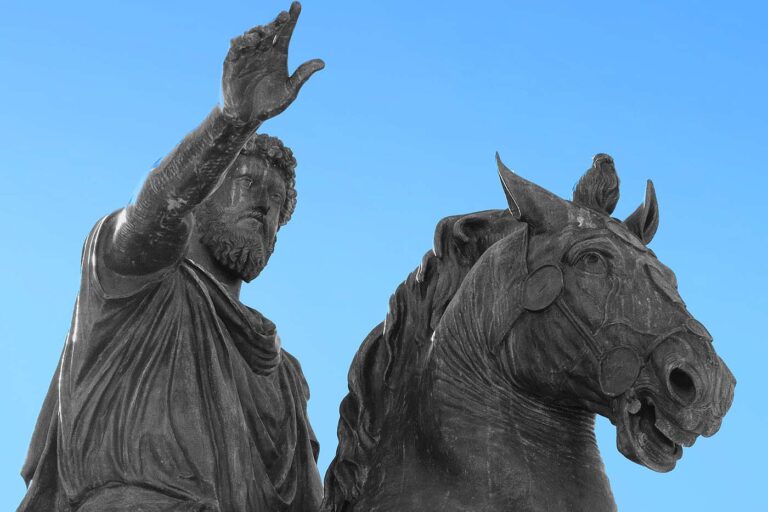
Marcus Aurelius (Emperor of Rome from 161 to 180 CE) gives us a different starting point. In the Meditations, the leadership is turned inward. His notes are not speeches to the empire; they are reminders to himself. Again and again, he returns to the discipline of perception, impulse, duty, mortality, and proportion. He asks himself not to be ruled by irritation, flattery, fear, or the behavior of others. For modern readers, Marcus Aurelius is often treated as a guide to resilience. This is true, but incomplete. His real leadership value lies in executive self-command. He understood that a person surrounded by power is constantly at risk of being in internal disarray. The first duty of such a leader is not to appear calm, but to become less governed by reaction.
Plutarch, writing in the first century CE, in his Parallel Lives, offers another kind of leadership school. He does not present abstract theory first. He presents lives, biographical studies. He places figures beside one another — Greek and Roman, noble and flawed, brilliant and dangerous — so that character can be studied through comparison. Alexander, Caesar, Alcibiades, Coriolanus, Demosthenes, Cicero, and many others become more than famous names. They become human cases. Plutarch is fascinated by the small signs that reveal a larger destiny: ambition, resentment, generosity, envy, courage, vanity, restraint, and the inability to hear correction. His great lesson for modern leadership is that talent does not save a person from himself. Brilliance without self-knowledge can become destructive. Charisma without restraint can damage the very world it seeks to command.
Cicero (106-43 BCE), especially in his De Officiis (“On Duties”), brings the discussion into the realm of duty, ethics, influence, and public responsibility. Writing in a Roman world marked by political collapse and personal danger, the influential Roman statesman, lawyer, and orator asks how a person should act when advantage and moral right appear to conflict. His answer is blunt: true usefulness cannot finally be separated from what is honorable. And that principle remains deeply relevant today. Many modern leaders do not fail because they cannot identify what is useful. They fail because they persuade themselves that usefulness justifies what is morally false, manipulative, or self-serving. Cicero reminds us that leadership is not only about producing outcomes. It is also about the kind of moral order those outcomes require and create.
These authors differ greatly from one another. Xenophon gives us a portrait of leadership through formation and example. Marcus Aurelius gives us the inner discipline of a ruler under pressure. Plutarch gives us comparative biography as moral diagnosis. And Cicero gives us the ethics of public duty and influence.
Together, they suggest that what we now call emotional intelligence is only one part of an older and larger discipline.
Self-awareness is necessary, but insufficient. A leader must identify the effects of anger, fear, ambition, resentment, envy, and approval-seeking inside himself or herself. Self-regulation is necessary, but not enough. The leader must not simply suppress emotion; he must also bring it under judgment. Empathy is necessary, but yet again, inadequate. A leader must understand others without becoming manipulative, sentimental, or captive to the mood of the crowd. Social skill, of course, is necessary, but alone, it is far from sufficient. Persuasion must remain answerable to truth.
This is where ancient leadership remains so useful. It refuses to detach skill from character.
Modern leadership education often separates competence from formation. It may teach communication, decision-making, influence, branding, strategy, culture, or performance while leaving the deeper person largely untouched. The ancients would have regarded that as dangerous. A more skilled but unformed leader is not necessarily safer. In some cases, they are simply more effective at spreading their internal disorder.
This does not mean that modern leadership should abandon contemporary psychology, organizational research, neuroscience, management theory, or practical training. Far from it. We need such tools. But tools become dangerous when the person using them has not been formed in judgment, restraint, and purpose. The ancient contribution, therefore, is not a replacement for modern knowledge. It is a correction of proportion.
Leadership is not only what a person can do. It is also what a person has become.
The lesson is urgently modern. We live in institutions that move quickly, reward visibility, amplify personality, and often promote people before their authority has matured. We have leaders with platforms, titles, followers, capital, offices, and technical competence. Yet many institutions still suffer from distrust, anxiety, performance theater, defensive communication, ethical drift, and the exhaustion that comes from being led by people who are outwardly capable but inwardly unstable.
The classical writers help us name the problem more clearly.
Xenophon asks whether leaders share the burden before demanding loyalty. Marcus Aurelius asks whether leaders govern their own reactions before governing others. Plutarch asks whether leaders know the character flaws that success will magnify. And Cicero asks whether leaders can distinguish true usefulness from attractive moral compromise.
These are not antiquarian questions. They belong in boardrooms, classrooms, cabinet rooms, military academies, public agencies, startups, nonprofits, universities, social enterprises, and a thousand other places. They belong anywhere power is given to human beings who may or may not have been formed well enough to bear it.
For students, the ancient world offers a serious invitation: do not wait for a title before beginning the work of leadership. Formation begins in small responsibilities, ordinary truthfulness, disciplined attention, and the willingness to receive correction.
For experienced leaders, the invitation is sharper: do not confuse power with authority — in the original Roman sense of the Latin word auctoritas, meaning legitimate power built upon reputation, experience, and societal standing. The fact that others must obey does not mean they trust. The fact that a strategy works does not mean it is honorable. And the fact that a leader remains calm in public does not automatically imply that they are inwardly free.
The ancient world understood that leadership is tested where pressure meets character.
That is why these texts still deserve attention. They do not flatter us. They ask better questions than many modern formulas. They remind us that the leader’s first field of command is not the organization, the army, the institution, or the state.
It is the self.And where the self remains ungoverned, every other form of leadership eventually becomes unstable.