The School of Athens and the Art of Enlightened Leadership: Power Disciplined by Truth
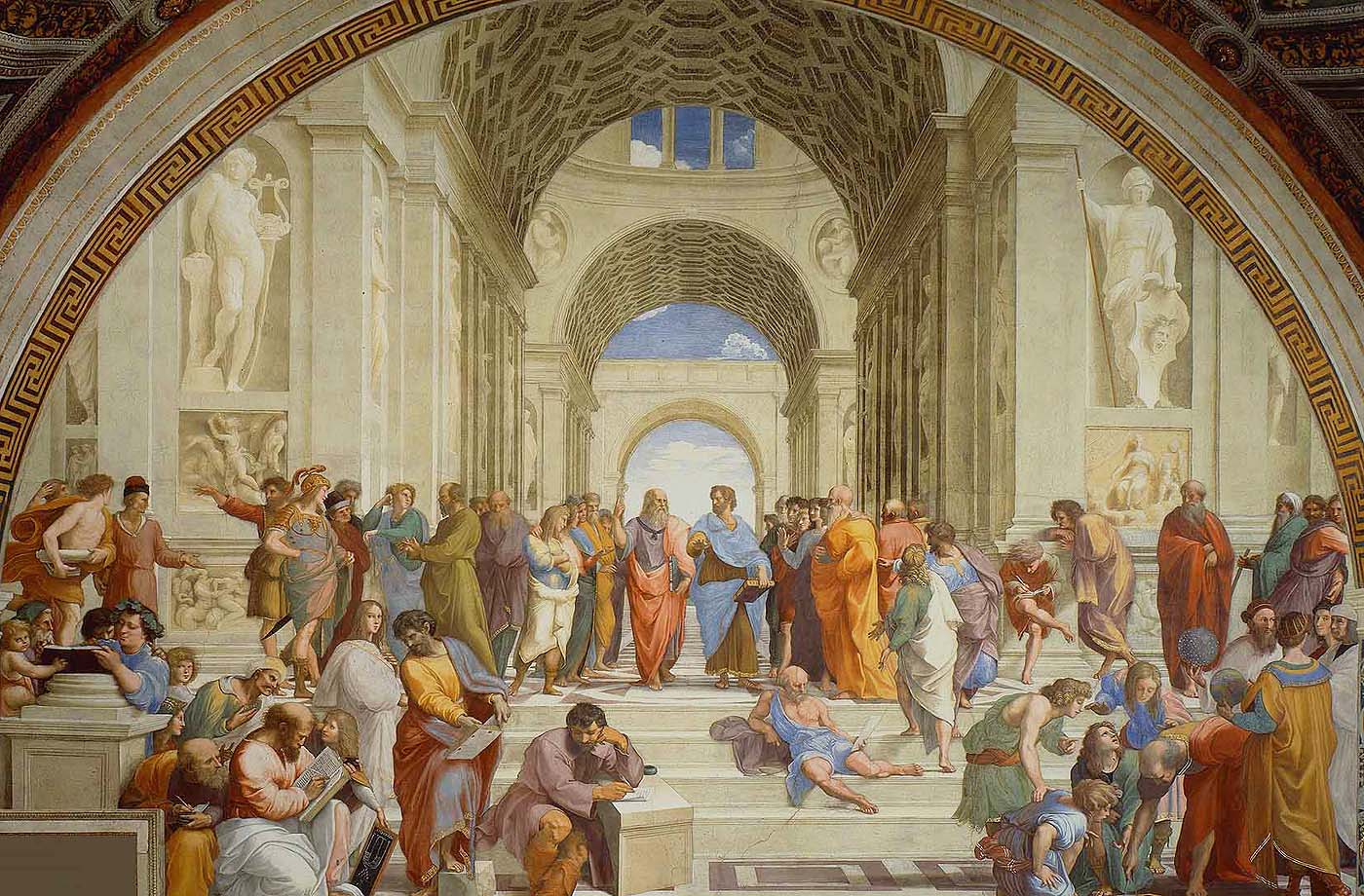
Raphael’s School of Athens is one of those rare images that doesn’t just depict an idea — it organizes an idea. Painted for Pope Julius II in the Vatican’s Stanza della Segnatura (one of the Raphael Rooms), it stages philosophy as a living public event: thinkers in motion, clustered in argument, teaching, listening, disputing, calculating, writing, and — crucially — sharing one space under one architectural horizon.
If you want to build a model of enlightened leadership that doesn’t collapse into slogans — “be authentic,” “communicate better,” “stay humble” — this fresco is a surprisingly rigorous starting point. It gives us a visual constitution for leadership: authority grounded in truth-seeking, ambition disciplined by meaning, power anchored in legitimacy, and awareness expressed as proportion, presence, and restraint. It even hints at a leader’s hardest task: integrating competing forms of knowledge without becoming a tyrant of one worldview.
Contemplate these differences further in the essay The Forgotten Difference Between Power and Authority — A Lesson Modern Leadership Has Ignored
1) A fresco about authority, not domination
Modern leadership culture is fluent in power — leverage, scale, control, strategy. But the School of Athens isn’t a mural of power. No one here commands. No one is enthroned. What governs the scene is authority, and authority in the ancient sense (the Latin concept of auctoritas comes to mind): earned credibility, moral weight, and the capacity to be followed without coercion.
That distinction matters: Power can force outcomes. Authority invites assent and sustains trust. Leadership becomes fragile when power outpaces authority, but it becomes durable when authority anchors power.
Raphael paints this difference without a single “leader” figure. Instead, he shows a field in which leadership is distributed: teachers and students, disputants and observers, specialists and generalists. The message is subtle but strong: enlightened leadership is less about commanding the room and more about creating the conditions in which truth can be pursued, tested, refined, and shared.
In practical terms, this reframes what a leader is for. Not merely to decide, but to cultivate legitimacy through coherence — inner alignment expressed in outer conduct. Authority, in this model, is not performed; it is embodied.
2) The center holds: Plato and Aristotle as the leadership tension
At the fresco’s vanishing point stand Plato and Aristotle, the gravitational pair that pulls everything else into coherence. Their gestures have become iconic: Plato points upward; Aristotle gestures down and outward. (Khan Academy’s reading is straightforward: Plato oriented to metaphysical ideals; Aristotle oriented to observable reality and ethics-in-practice.)
Seen as leadership, this is not a debate you “win.” Rather it’s a polarity you hold.
- Plato represents the leader’s responsibility to first principles: truth, justice, meaning, the Good — what should not be negotiated away for convenience.
- Aristotle represents the leader’s responsibility to the world as it is: evidence, consequence, practicality, and the grounded work of shaping real institutions.
Enlightened leadership fails when it absolutizes one side. Platonic leadership without Aristotle becomes ungrounded moralizing — beautiful ideals with no operational integrity. Aristotelian leadership without Plato becomes clever pragmatism — efficient, adaptable, and ultimately hollow.
The fresco’s compositional logic refuses that split. The crowd does not gather around Plato alone or Aristotle alone. It gathers around their relationship, their dynamic tension, the living question between them. That is a core principle for a mature leadership model: not certainty, but integration.
3) Architecture as a lesson in coherence
Raphael’s architecture isn’t just a setting; it’s a metaphor for governance. Linear perspective pulls the entire scene toward a single horizon. Every figure has freedom of posture and emphasis, yet the world still has structure.
This is what enlightened leadership looks like inside organizations: not uniformity, but coherence. People can disagree, specialize, and even compete — without the system fragmenting — because there’s a shared center: a purpose that is clear enough to orient action, and stable enough to endure argument.
In our Principio project, this is where authority is felt as legitimacy: a shared belief that decisions are oriented toward something beyond ego and expediency.
The practical leadership takeaway is almost architectural:
Design a moral and strategic “vanishing point.”
Make it visible. Return to it. Let it organize disagreement rather than suppress it.
4) Sacred ambition: excellence without extraction
The School of Athens is animated by aspiration. But it’s not the ambition of status anxiety or conquest. It is ambition as devotion to excellence — to understanding, to disciplined inquiry, to a larger order of meaning. This aligns with an older view: ambition not as a private appetite, but as a force that must be oriented toward what it serves.
You can refer to the essay When Ambition Was Sacred: What Ancient Civilizations Understood About Success That We Don’t.
Modern leadership often treats ambition as morally neutral and results-driven: if it “works,” it’s justified. Ancient cultures were tougher: ambition had to be accountable to virtue, justice, harmony — otherwise it turned corrosive.
Raphael encodes this by showing ambition expressed as study, dialogue, and craft. The scene implies: real greatness is not grabbing the crown; it’s submitting to the discipline of truth.
For leadership, this becomes a test you can actually apply:
- Does your ambition extract — from people, attention, culture, time — just to prove your worth?
- Or does it contribute — building capacity, transmitting knowledge, strengthening the whole?
The fresco is crowded, but not frantic. It’s energetic, but not desperate. That difference is the difference between ambition that consumes and ambition that is “consecrated” — ambition that has found its higher horizon.
5) Awareness over efficiency: why the scene is “busy” on purpose
If you wanted an image of efficiency, you’d paint a single decisive figure issuing orders. Raphael does the opposite: he paints complexity — many simultaneous conversations, multiple centers of activity, overlapping projects.
That’s not mess. That’s awareness.
My essay on awakened leadership makes the point bluntly: the leaders who shaped civilizations weren’t the most efficient; they were the most awake — able to sense timing, moral context, human nuance, and long-term consequence.
Refer to The Leaders Who Changed History Were Not the Most Efficient — They Were the Most Awake.
The School of Athens is awareness rendered visible. It suggests an enlightened leader is less like a stopwatch and more like a conductor: hearing the whole, noticing subtle shifts, giving proportion to competing goods, and resisting the modern compulsion to equate speed with wisdom.
A leader who sees only metrics will miss the human truth in the room. Raphael’s crowd is a reminder that what matters most in knowledge-work (and in leadership) often happens in the spaces between directives: informal debate, apprenticeship, the slow maturation of insight.
6) Authority is relational: groups, teachers, learners
One of Aristotle’s most practical insights — echoed in the essays about authority on this site — is that authority is relational. It exists in the bond between leader and community, and it depends on recognition and trust.
Raphael depicts that relational reality everywhere. People lean in. They gesture. They mirror postures. They cluster around a teacher. They form temporary communities of inquiry. No one “owns” the truth; truth is approached through shared pursuit.
This is an enlightened leadership stance: leadership as stewardship of relationship.
It’s also a quiet warning. If leadership becomes a monologue, authority thins and power takes over. If you have to constantly “assert” your role, the fresco implies, you’ve already lost the room. Authority doesn’t shout. It gathers.
7) Humility and the second mountain: after success, what then?
The Renaissance context matters. Raphael paints the rebirth of classical wisdom inside a papal apartment — a deliberate synthesis of reason, faith, and culture within the Stanza della Segnatura’s broader program.
But there’s another layer: Raphael reportedly includes himself at the edge of the gathering, not at the center. Vatican Museums’ description notes a self-portrait “on the extreme right with the black beret.” The symbolism is almost too clean: the artist participates in the tradition he inherits, but he does not crown himself as its culmination.
That posture maps onto what can be described as the “second mountain” transition: moving from achievement to contribution, from proving to serving, from expansion to depth. See the essay The Second Mountain Is Older Than We Think — A Journey Through Philosophy, Faith, and Leadership
In leadership terms: the first mountain is building competence, influence, and success. The second mountain is learning what to do after that — how to convert success into stewardship rather than entitlement.
The School of Athens is a second-mountain image because it treats greatness as transmission. The highest act is not winning the debate; it’s strengthening the lineage of thought so others can surpass you.
8) Burnout as misalignment: the fresco’s antidote
Look again at the energy of the room. It’s intense, but it’s not depleted. The work feels meaningful. People aren’t performing productivity; they’re participating in something that matters.
My essay on burnout argues that burnout is often not a time-management failure but a crisis of meaning—effort divorced from inner alignment. See Why Burnout Is a Spiritual Crisis, Not a Time-Management Problem.
The fresco offers a corrective: a model of work animated by purpose, community, and truth-seeking rather than status maintenance.
That’s not romanticism, it’s operational wisdom:
- When leaders are oriented toward legitimacy and meaning, urgency quiets down.
- When leaders chase power without authority, systems get louder, faster, and more brittle — until people break.
Enlightened leadership, then, is not “softer.” It is more sustainable because it is more coherent.
A practical model of enlightened leadership from the fresco
If we translate the School of Athens into a usable leadership model, it looks like this:
- Set a shared horizon (coherence).
Create a clear “vanishing point” purpose that can hold disagreement without fragmentation. - Integrate ideals and reality (Plato + Aristotle).
Hold first principles and practical consequences together; refuse the false choice. - Cultivate authority, not just power.
Earn legitimacy through coherence, restraint, and responsibility. - Consecrate ambition.
Measure success by what it serves, not just what it gains. - Choose awareness over performative efficiency.
See depth, timing, and human nuance as strategic assets, not “soft extras.” [Refer to the essay The Leaders Who Changed History Were Not the Most Efficient — They Were the Most Awake - Lead relationally.
Build trust by hosting dialogue, enabling learning, and distributing agency. - Step into second-mountain stewardship.
Treat achievement as a threshold into responsibility and transmission, not a trophy.
Raphael’s fresco endures because it refuses a cheap answer to what leadership is. It proposes something harder and truer: leadership is the art of ordering a human world around truth — without crushing difference, without idolizing power, and without losing the soul of the enterprise in the name of speed.
And that, in the end, is what enlightened leadership looks like: not the lone hero at the center, but the quiet authority that makes a whole room more intelligent, more humane, and more awake.